

Files
Download Thumbnail Sheet (21.1 MB)
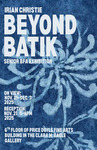
Download BeyondBatikPoster.IrianChristie.PNG (5.5 MB)
Download Justin.IrianChristie.heic (1.4 MB)
Download MommyAndMe.IrianChristie.jpg (902 KB)
Download Papa.IrianChristie.jpg (101 KB)
Download ThreeLittleBirds.IrianChristie.heic (1.0 MB)
Download Wildflowers.IrianChristie.JPG (3.8 MB)
Download Jarik.IrianChristie.jpg (1.1 MB)
Download HomeSweetHome.IrianChristie.heic (987 KB)
Download TuckedIn.IrianChristie.heic (1.6 MB)
Download ExhibitionAngle1.IrianChristie.jpg (564 KB)
Download ExhibitionAngle2.IrianChristie.jpg (202 KB)
Download ExhibitionAngle3.IrianChristie.jpg (740 KB)
Download ExhibitionAngle4.IrianChristie.JPG (372 KB)
Download ExhibitionAngle5.IrianChristie.jpg (566 KB)
Download ExhibitionAngle6.IrianChristie.JPG (712 KB)
Download BusinessCardHorizontal.IrianChristie.PNG (2.2 MB)
Download ExhibitionAngle7.IrianChristie.JPG (1.5 MB)
Download BusinessCardVertical.IrianChristie.PNG (2.0 MB)
Academic Level at Time of Creation
Senior
Date of Creation
Fall 11-21-2025
Artist Statement
I create batik works to tell stories about family, culture, and identity shaped by experiences. As an Asian American artist born in the United States, with roots in the American South and Indonesian, I use batik portraiture to explore how my two cultures meet and shape my identity. Batik began in Indonesia and is often defined by repeating patterns and motifs. My work extends the tradition into portraiture to explore identity and belonging. I use batik to portray people, to reflect relationships, and to hold space for what feels sacred, especially in a world that often asks us to separate or simplify who we are.
My process begins with traditional methods using wax-resist techniques with beeswax, natural dyes, and cotton. I build on those core methods by layering imagery, shifting color, and moving the work toward portraiture. I often use flowers to represent people. Each motif is chosen with care, tied to a trait, a moment, or a memory. These details become a way to preserve stories visually, connecting the people in my life to my cultural practices. Through this, I try to hold on to what matters: the people, the experiences, and the parts of myself they’ve shaped.
This work is not just about technique. It is about making the person feel present to the viewer. It speaks to identity and asks questions about belonging. As someone raised in a mixed household, I’ve always lived between cultures. I’ve seen how people try to define “American” through their perspectives, and how racism, xenophobia, and fear of difference continue to shape that definition. But my life is evidence of something more honest: that America is built from many cultures, many families, many stories. Making this work helps me feel like I belong in that story, too.
Artists like Bisa Butler influence me through her use of textiles to capture identity and memory with emotional depth. Yinka Shonibare’s reimagining of history through fabric and symbolism speaks to my own blending of cultural traditions in a contemporary American context. Sri Irodikromo’s use of batik in portraiture reminds me that this medium is not only traditional but that it is expressive, and capable of carrying deeply personal narratives.
Research plays an essential role in my practice. I study batik not only as a technique but as a cultural language, asking how resistance (both physically through wax and conceptually through expression) can carry meaning. I reflect on removal, repetition, and layering as ways to understand how identity is formed and revealed, not only as materials. Each mark carries weight.
Teaching and sharing are also part of my process. I want my work to open conversations not just about beauty or craft, but the deeper ties between history, cultural traditions, and human connection. I want viewers to understand that batik is not frozen in the past but that it’s alive. It can hold emotion. It can speak. In every piece, I try to preserve what matters, honor what shaped me, and make a space for stories like mine.
Advisor/Mentor
April Webb; Dr. Antje Gamble; Sarah Martin; Lu Colby
Description
This practice-led study treats batik, a wax-resist dye process on cotton, as a material language for portraiture that links personal narratives with technical control. Rather than asking whether batik can be used for portraiture, the project shows how traditional methods such as wax resistance, selective removal, and layered color can be tuned to make clear portraits while looking into textile makers and history. I work on cotton only (muslin and voile), using Procion-type fiber-reactive dyes and beeswax and paraffin as the resist. Studio decisions focus on fabric density, wax heat matched to fibers, tool choice, and dye-to-water balance. Outcomes are assessed with observational criteria: edge clarity, halo (a soft ring of dye at the boundary) control, undertone accuracy, and color stability after drying and handling. Findings show that matching wax flow to fabric density produces clean, unbroken edges. Middle-consistency dye mixes reduce uncontrolled bleed while allowing tonal buildup. A thin beeswax seal protects finished portraits without soaking steps. Conceptually, resistance, removal, and layering operate as a language of care, revision, and time.
Creative Commons License

This work is licensed under a Creative Commons Attribution 4.0 International License.
Recommended Citation
Christie, Irian S., "Beyond Batik" (2025). B.F.A. Practicum Exhibition (ART 498). 162.
https://digitalcommons.murraystate.edu/art498/162